27 October 2012

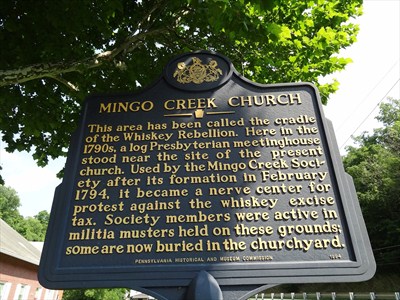
Mingo Creek Association


The Whiskey Rebellion by William Hodgeland, 2006, Excerpts

Even as Alexander Hamilton began considering ways of bringing a federal army presence to the Forks of the Ohio, five hundred men calling themselves the Mingo Creek Association emerged as a power at the Forks. The association had a long ancestry. Men who became members and allies of the association had, in the years leading to ratification of the U.S. Constitution, closed roads to towns where debt cases were heard and foreclosed property was auctioned; they’d enforce boycotts on liquor brought in from the east, they’d condemned tax collectors, and they’d corresponded with Virginians and Kentuckians of the need for western unity.

When word spread that a deputy was trying serve papers in the Johnson case, the tax collector encountered a gang that took him into the woods and began by using a horsewhip on him. His naked body, stripes new and raw, received the blistering tar. He was stuck with feathers, tied up, and left in the woods in agony, his horse, money, and warrants seized.

Now the association set goals far broader than attacks on collectors. It planned to unite the four western counties, and the whole trans-Appalachian west into armed opposition to eastern oppression. Conveniently for the association’s plans, the sanctioned state militias, which organized and armed all able-bodied adult white males, was subject to extreme degrees of popular democracy. From Colonels down, officers were elected by the militiamen themselves, including by landless men and dependents in others’ households. Anyone possessed of charisma and effectiveness, even if lacking gorgeous uniforms, proud mounts, gleaming arms, or money, could rise in the militia system.

The association took an even more radical step. Creditors had been finding debt cases easier to bring and win. No citizen in the militia’s district, the association announced, was to bring suit in county court against any other citizen in the district without first applying to the association for what it presented as mediation. Mediators would be chosen by popular elections, held outside sanctioned political process.

Not surprisingly, given the association’s identity with the local militia, and the assaults for which it was becoming known, lawsuits for debt collection in the county court dropped off sharply. Going to law to collect debts or bring foreclosures suddenly took courage, even foolhardiness.


Consolidation of the Spirits Industry


The Whiskey Rebellion by William Hodgeland, 2006, Excerpts

Hamilton’s inspiration was the British Empire, where distilling and government had a long history together. From as early as the seventeenth century, large distillers had actually favored whiskey excises – had even contributed expertise to helping the government write excise laws. In 1785, an act of Parliament gave a tax rebate to big distillers, and later acts went all the way, placing an outright ban on small stills, making it actually criminal in England to distill on anything but the largest scale. Even as the U.S. Congress was passing its whiskey tax in 1791, Parliament was banning stills of less than five-hundred-gallon capacity.

The goal was industry consolidation. Hamilton had learned from the English that commercial agriculture and large industry, when publicly chartered, given tax breaks, and financed by large loans, might turn the United States into an industrial empire to compete with England’s. Big distilling had the potential, given American drinking habits, to be highly profitable – yet small, seasonal producers, especially in the west, competed with industrial distillers and kept revenues scattered, engines weak. Hamilton’s whiskey tax didn’t merely redistribute wealth from the many to the few and subdue rural economies; it also served as one of the heavier cogs in a machine for restructuring all of American life.

In every configuration, on every level, Hamilton had designed the law to charge small producers who could least afford it a higher tax. And the most significant effect of the higher tax was that it would, as Hamilton said, have to be passed on to consumers. Small producers would have to raise prices. Big producers could lower prices, sharply underselling the small distillers, taking over their customers, ultimately driving the small producers out of business. Closing down local whiskey economies, the whiskey tax pushed self-employed farmers and artisans into the factories of their creditors.


26 October 2012

Mechanics of the Whiskey Tax


The Whiskey Rebellion by William Hodgeland, 2006, Excerpts

A federal tax on whiskey was hardly, to the small distillers who made up the majority that would pay it, the mere luxury-tax-with-concomitant-health-benefit that Hamilton had described to a Congress eager to be swayed.

The poorest people, hired hands paid in kind, experienced the whiskey excise as a tax on income: if community distillers had to pay the tax, they’d have to compensate themselves by taking a larger share of whiskey from people who brought their grain salaries in for conversion. Growers too felt the pain. There was no tax on grain, but westerners who raised grain were forced to convert grain to whiskey in order to transport it eastward. The tax thus imposed a federal tax on western farmers while leaving farmers in more convenient and prosperous places untaxed.

The duty would be collected by federal officers, in coin, at the point of production, often a log stillhouse on a small farm. Having collected the duty or secured the bond, the deputy then issues a certificate stamped with a Treasury Department seal. The certificate is the prize. It travels with the whiskey, proving to buyers that the duty has been paid. Certification makes the product legal.

It wasn’t clear where cash for the payment would come from, and failure to pay would make the product non-transportable. Not registering a still was punishable by a cash fine. Assets – the whiskey and the still itself – could be seized.


25 October 2012

Whiskey and the Frontier


The Whiskey Rebellion by William Hodgeland, 2006, Excerpts

Whiskey came in vogue early in the eighteenth century with the influx of Scots-Irish settlers, who brought expertise in domestic distilling. The Scots-Irish were notably tough descendants of Protestant Scots peasantry, who had resettled in Ulster and then been forced, by exorbitant rents and English taxes, to migrate to North America. By the time of the revolution, domestic whiskey was gaining popularity and would replace rum as the country’s drink.

Eighteenth-century Americans distilled whiskey just as their ancestors had, using a pot still. The good product was clear. Inhaling it would water the eyes and rustle nose hairs. Swallowed, it made a hard impact, then a glowing heat; in the end, the feeling was surprisingly smooth, and soon after recovery, another shot might seem to be in order. Barrel storage darkened the drink and brought out redolent grain, woodsmoke, sugar. Drunken raw or aging, whiskey abruptly makes the drinker and the world different.

Many small farmers distilled seasonally. Whiskey was consumed by men, women, and children at all times of the day and every sort of gathering muster, church, election, work, dance, and fight. Often a community distiller kept pot stills going through the harvest, and farmers brought in their grain and took away the whiskey, paying the distiller in a portion of product.

The best whiskey was known to come from the Forks of the Ohio, whose “Monongahela rye” possessed consistent strength and purity. The region achieved brand recognition. Its whiskey was known by name in Philadelphia and in New Orleans. More than a fourth of the stills in America were located at the Forks of the Ohio.

Whiskey became currency in places where coin wasn’t seen. Barter paralyzed local economies, but whiskey was a true medium, always exchangeable for cash somewhere down the line, thus maintaining value against metal. A liquid commodity both literally and figuratively, the drink democratized local economies, offering even tenants and sharecroppers laborers a benefit. Tenants often wanted to pay rent, and laborers often got paid, in a portion of the grain they harvested. Community stills transformed, for a cut, such cumbersome forms of payment into something fungible. And while landlords often refused in-kind crops, or demanded them in extravagant quantities, they’d take whiskey for rent. 


Whiskey Tax 1791


The Whiskey Rebellion by William Hodgeland, 2006, Excerpts

Hamilton’s goal for the domestic debt remained making reliable payments to creditors and inspiring confidence in federal bonds as articles of investment and trade. Wealth would be concentrated in the hands of moneyed investors. Their ambitions would fund the nation’s ambitions.

In January of 1790, Hamilton filed his proposed plan, the Report on Public Credit. The product Hamilton proposed to tax was distilled spirits. Hamilton presented a letter for the Philadelphia College of Physicians, who said that domestic distilled spirits, the cheap drink of the laboring classes, had become a ravaging plague requiring immediate treatment. It was easy to see a federal excise tax on whiskey as an innocuous luxury tax, easily passed on by distillers to drinkers, surely nothing to tar and feather anyone over.

March of 1791, the Whiskey Tax became law. The tax redistributed wealth by working itself deeply into rural people’s peculiar economic relationship with whiskey. Many of Hamilton’s congressional opponents wouldn’t have understood that relationship. Hamilton did. Alexander Hamilton knew that in getting the act passed was a very smart bomb on a target he’d been softening for years. The secretary of treasury was celebrating a victory in a long struggle over nothing less than the power of money in the lives of the American people.

Passed by the first Congress of the United States in March 1791 heralded the first federal tax on an American product.