08 February 2017

Managing the Bewildered Herd


Media Control by Noam Chomsky, 2002, Excerpts

People have to be atomized and segregated and alone. They’re not supposed to organize, because then they might be something beyond spectators and enter the political arena. That’s really threatening. They ought to be sitting alone in front of the TV and having drilled into their heads the message, which says, the only value in life is to have more commodities or live like that rich middle class family you’re watching and to have nice values like harmony and Americanism. Every once in a while you call on them to chant meaningless slogans like “support our troops.”

You've got to keep them pretty scared, because unless they’re properly scared and frightened of all kinds of devils that are going to destroy them from outside or inside or somewhere, they may start to think, which is very dangerous, because they’re not competent to think. Therefore it’s important to distract them and marginalize them.

The media is a corporate monopoly. They have the same point of view. The two parties are two factions of the business party. Most of the population doesn’t even bother voting because it looks meaningless. They’re marginalized and properly distracted. The population has to be driven back to the apathy, obedience and passivity that is their proper state.


28 January 2017

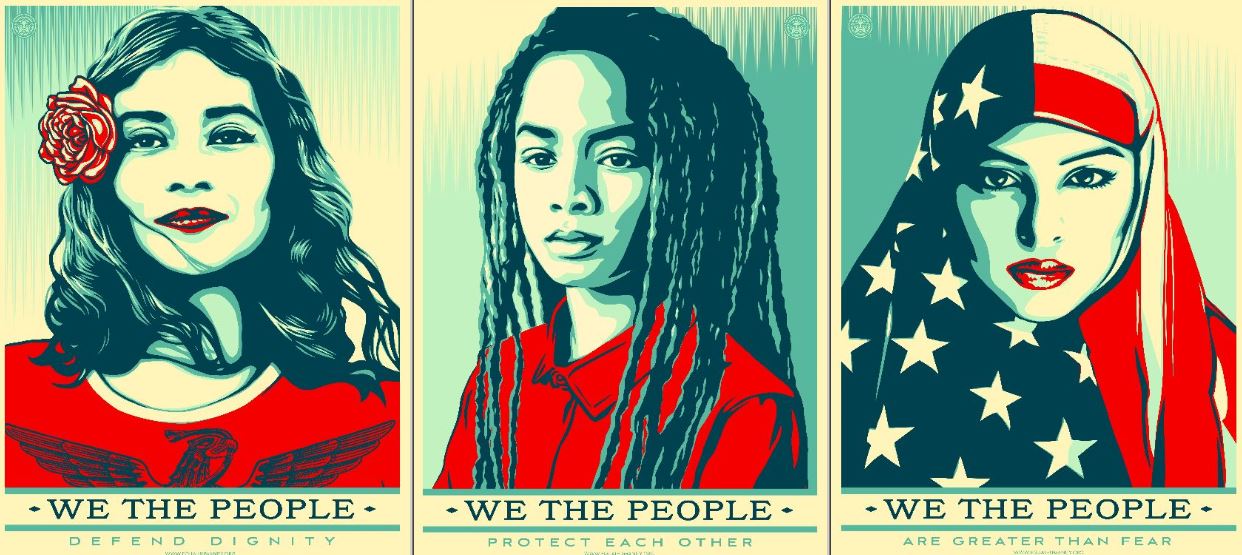
Shepard Fairey: Warning or an Endorsement?


Shepard Fairey is the street artist for the famous Obama-Hope posters popularized during the 2008 election. The poster became part of the permanent collection at the US National Portrait Gallery. After perusing his works in the Shepard Fairey gallery, was he spoofing Obama or endorsing him, was it an artful warning? Such is the Riefenstahlian dilemma.

It appears he was sincere in his Obama endorsement in 2008, but has since become disillusioned with the two-party system. His theme got hijacked and is now a disarmed popularized style. No doubt good for his pocketbook, but not consistent with the original artistic theme. Then there was the AP lawsuit which is now settled.

Now with Obama out of office, looks like Fairey may be back in vogue. Sales of George Orwell’s 1984 are up [Fairey did the book cover], and Fairey’s posters were widely seen at the Women’s mach.

George Orwell's '1984' hits bestseller list again
25 Jan 2017
2017 has been "doubleplusgood" for sales of George Orwell's "1984." The famed dystopian novel of life in a totalitarian state sat at No. 6 on Amazon's bestseller list Tuesday morning. The novel's newfound popularity comes several days after White House press secretary Sean Spicer argued defiantly that Trump's swearing-in Friday drew the largest-ever audience for an inauguration "period," despite obvious photo and statistical evidence to the contrary. Senior Trump adviser Kellyanne Conway later defended that argument by saying Spicer's false claims were actually "alternative facts." That phrasing was reminiscent of Orwell's "Ministry of Truth," which, he wrote, concerns itself with "lies."


'Hope' poster creator says he's run out of hope for Obama
29 May 2015
Shepard Fairey says he's run out of hope for President Barack Obama. Fairey is a street artist who is behind the designs for the clothing line OBEY, was featured in the Banksy documentary "Exit Through the Gift Shop" and is most known for designing Obama's famous "Hope" poster. Fairey designed the poster for Obama's 2008 campaign and it became the optimistic symbol of his presidential campaign. When Esquire asked Fairey if Obama lived up to his "Hope" poster, Fairey responded, "Not even close." Fairey told Esquire that he never thought Obama would compromise on issues such as drones and domestic spying.


Obama 'Hope' poster artist Shepard Fairey fined
07 Sep 2012
The US artist who created the well-known "Hope" poster featuring President Barack Obama has been given two years probation and fined $25,000 (£15,000) in a criminal contempt case. He had based his poster on an AP photo and later tried to hide the evidence. Mr Fairey was spared jail but will do 300 hours of community service. The case was settled out of court before a decision was reached, with Mr Fairey agreeing to pay an undisclosed amount of compensation and the two sides agreeing to share the rights to make posters and merchandise bearing the "Hope" image.

Associated Press sues retailers over iconic Obama image
11 Mar 2011
The Associated Press has sued several retailers including Urban Outfitters for the unauthorized use of the Hope image created by artist Shepard Fairey. Street artist Fairey used the photo, taken by Mannie Garcia in 2006, when he created his Hope artwork during Barack Obama's 2008 presidential campaign. Fairey sued AP in 2009, seeking a declaration he had not violated its copyright with his iconic image. AP then counter-sued, saying he had done so through his uncredited and uncompensated use of its picture. The deal agreed in January called for both sides to work together with the image and share future rights to merchandise based on it. 

"Hope" Artist Shepard Fairey Not Pleased With Obama's Performance
In creating his now iconic Obama "Hope" poster, Shepard Fairey went from being a cult street art figure to an artist synonymous with Barack Obama’s revolutionary 2008 presidential campaign. But the artist, whose stylized portrait was emblematic of change, said he hasn't been wowed by Obama's performance in the White House thus far. “Obama is to me a quality human being and someone that, given the limitations of the two-party system, that’s trying to do a good job. The two-party system is not yielding the results I want to see.”

Obama poster artist Shepard Fairey is arrested on tagging charges
08 Feb 2009
Fairey was arrested Friday night in Boston on his way to the Institute of Contemporary Art to DJ at a sold-out party kicking off his first solo exhibition, “Supply and Demand.” Two arrest warrants had been issued Jan. 24 after police determined that he had tagged property in two locations with his street art campaign featuring Andre the Giant and the word "obey," said Boston police officer James Kenneally.

Copyright battle over Obama image
05 Feb 2009
The Associated Press is claiming compensation for the use of one of its photographs to create the most iconic image of Barack Obama. Speaking in an interview with the BBC World Service before the copyright row erupted, he said he was more accustomed to making negative posters of politicians, but was inspired to create a positive image of Barack Obama when he heard him speak at the 2004 Democratic National Convention.


After the Obama poster, Mad Magazine spoofs the style 


23 November 2016

Democracy and Indians


Lies My Teacher Told Me by James Loewen, 1995, Excerpts

Native American ideas may be partly responsible for our democratic institutions. Democracy is an example of syncretism, combining ideas from Europe and Native America. Native ideas of liberty, fraternity, and equality found their way to Europe to influence social philosophers such as Thomas More, Locke, Montaigne, Montesquieu, and Rousseau. Through 150 years of colonial contact, the Iroquois League stood before the colonies as an object lesson in how to govern a large domain democratically.

American Indians are directly or indirectly responsible for the public-meeting tradition, free speech, democracy, and all those things which got attached to the Bill of Rights. Without the Native example, do you really believe that all those ideas would have found birth among a people who had spent a millennium butchering other people because of intolerance of questions of religion?

For a hundred years after our Revolution, Americans credited Native Americans as a source of their democratic institutions. Revolutionary-era cartoonists used images of Indians to represent the colonies against Britain. Virginia’s patriot rifle companies wore Indian clothes and moccasins as they fought the redcoats. When colonists took actions to oppose unjust authority, as in the Boston Tea Party, they chose to dress as Indians, not to blame Indians for the demonstrations, but to appropriate a symbol identified with liberty.


03 November 2016

Differences of an Economic Vision


The Whiskey Rebellion by William Hodgeland, 2006, Excerpts

The whiskey rebels weren't against paying taxes. They were against what they called unequal taxation, which redistributed wealth to a few holders of federal bonds and kept small farms and businesses commercially paralyzed. Farmers and artisans, facing daily anxiety over debt foreclosure and tax imprisonment, feared becoming landless laborers, their businesses bought cheaply by the very men in whose mills and factories they would then be forced to toil. They saw resisting the whiskey tax as a last, desperate hope for justice in a decades-long fight over economic inequality.

Some of the whiskey rebels envisioned stranding the seaboard cities, vile pits of unrestrained greed, on the far side of the Appalachian ridge and leaving the coast a vestige. Some imagined a new west, spiritually redeemed, with perfect democratic and economic justice: small farmers, artisans, and laborers would thrive, while bankers, big landowners, and lawyers would be closely regulated, even suppressed. Believing they could wrest their country back from frontier merchants and creditors, the rebels wanted to banish big businessmen as traitors to the region even while fending off the distant federal government in all its growing might.

Alexander Hamilton and his allies saw enforcing the whiskey tax as a way of resolving that fight in favor of a moneyed class with the power to spur industrial progress.