02 April 2017

George Orwell's 1984


1984 by George Orwell, 1949, Excerpt

War is Peace.
Freedom is Slavery.
Ignorance is Strength.

A few agents of the Thought Police moved always among them, spreading false rumors and marking down and eliminating the few individuals who were judged capable of becoming dangerous; but no attempt was made to indoctrinate them with the ideology of the Party. It was not desirable that the proles should have strong political feelings. All that was required of them was a primitive patriotism which could be appealed to whenever it was necessary to make them accept longer working hours or shorter rations. And even when they became discontented, as they sometimes did, their discontent led nowhere, because, being without general ideas, they could only focus it on petty specific grievances. The larger evils invariably escaped their notice.


George Orwell's 1984 heading for Broadway
03 Feb 2017
Dystopian novel 1984 has been topping US bestseller lists in recent weeks - and now a stage version previously seen in the West End is heading to Broadway. Its talk of "newspeak" and surveillance seem to have struck a nerve recently. Sales of the George Orwell book rose after US president Donald Trump's adviser said the White House was issuing "alternative facts" over the size of the crowds at his inauguration. In the book, society is run by The Party which is led by a shady figure called Big Brother - "Big Brother is watching you". The Party uses simplistic slogans to warp reality, like Black is White, 2+2=5, War is Peace, Freedom is Slavery, Ignorance is Strength.

George Orwell's '1984' hits bestseller list again
25 Jan 2017
2017 has been "doubleplusgood" for sales of George Orwell's "1984." The famed dystopian novel of life in a totalitarian state sat at No. 6 on Amazon's bestseller list Tuesday morning. The novel's newfound popularity comes several days after White House press secretary Sean Spicer argued defiantly that Trump's swearing-in Friday drew the largest-ever audience for an inauguration "period," despite obvious photo and statistical evidence to the contrary. Senior Trump adviser Kellyanne Conway later defended that argument by saying Spicer's false claims were actually "alternative facts." That phrasing was reminiscent of Orwell's "Ministry of Truth," which, he wrote, concerns itself with "lies."

07 March 2017

In which countries is Coca-Cola not sold?


Tamil Nadu: Traders ban Pepsi, Coca-Cola to support local products
01 Mar 2017

Traders in the southern Indian state of Tamil Nadu have banned the sale of Coca-Cola and Pepsi in favor of local products. The associations say that soft drinks firms take too much water from rivers, leaving farmers struggling to irrigate their land at a time of severe drought. "Drinks like Pepsi and Coca-Cola are not good for your health because of their high sugar and chemical content. We are promoting Indian soft drinks, and will encourage better sales of fruit juices."  The Indian Beverage Association (IBA) said the ban "was against the proven fundamentals of robust economic growth.” More than a million shopkeepers are expected to comply with the ban. Pepsi and Coca-Cola have not commented on the ban.

Coca-Cola opens its first plant in Burma for 60 years
04 Jun 2013
Coca-Cola has opened a bottling plant in Burma - the first time it has had a production facility there for more than 60 years. The world's largest soft-drink maker is one of the first US firms to invest in Burma following Washington's decision to suspend sanctions against the country. Coca-Cola has pledged to invest $200 million, and create thousands of jobs. There are now only two countries where the company does not do business. It left Cuba after the revolution, when Fidel Castro's government began seizing private assets, and it has never operated in North Korea.

In which countries is Coca-Cola not sold?
11 Sep 2012
After almost 60 years, Coca-Cola is on sale again in Burma. It's one of the world's most recognized brands, so are there any countries where the drinks giant still remains unsold? There are now just two countries in the world where Coca-Cola cannot be bought or sold - at least, not officially. They are Cuba and North Korea, which are both under long-term US trade embargoes (Cuba since 1962 and North Korea since 1950).

Coca-Cola's entry into any country is a powerful symbol, says Tom Standage, author of A History of the World in Six Glasses. "Coca-Cola is the nearest thing to capitalism in a bottle.” Not all countries have embraced the American-ness that seems to be embodied by Coca-Cola. It was the French who first coined the pejorative term "coca-colonization" in the 1950s. Trucks were overturned and bottles smashed as protesters saw the drink as a threat to French society. During the Cold War, Coca-Cola became a symbol of capitalism and a fault-line between capitalism and communism.


In 2003, protesters in Thailand poured Coca-Cola onto the streets as a demonstration against the US-led invasion of Iraq, and sales were temporarily suspended. Iran's president Mahmoud Ahmadinejad has threatened to ban Coca-Cola and Venezuela's Hugo Chavez recently urged people to drink locally-made fruit juice rather than drink Coca-Cola or Pepsi.


Coca Cola announced plans to invest a record $4 billion in China between 2012 and 2014. It is the company's biggest ever China investment following the $2 billion it invested in the country in 2009.

08 February 2017

Managing the Bewildered Herd


Media Control by Noam Chomsky, 2002, Excerpts

People have to be atomized and segregated and alone. They’re not supposed to organize, because then they might be something beyond spectators and enter the political arena. That’s really threatening. They ought to be sitting alone in front of the TV and having drilled into their heads the message, which says, the only value in life is to have more commodities or live like that rich middle class family you’re watching and to have nice values like harmony and Americanism. Every once in a while you call on them to chant meaningless slogans like “support our troops.”

You've got to keep them pretty scared, because unless they’re properly scared and frightened of all kinds of devils that are going to destroy them from outside or inside or somewhere, they may start to think, which is very dangerous, because they’re not competent to think. Therefore it’s important to distract them and marginalize them.

The media is a corporate monopoly. They have the same point of view. The two parties are two factions of the business party. Most of the population doesn’t even bother voting because it looks meaningless. They’re marginalized and properly distracted. The population has to be driven back to the apathy, obedience and passivity that is their proper state.


28 January 2017

Shepard Fairey: Warning or an Endorsement?


Shepard Fairey is the street artist for the famous Obama-Hope posters popularized during the 2008 election. The poster became part of the permanent collection at the US National Portrait Gallery. After perusing his works in the Shepard Fairey gallery, was he spoofing Obama or endorsing him, was it an artful warning? Such is the Riefenstahlian dilemma.

It appears he was sincere in his Obama endorsement in 2008, but has since become disillusioned with the two-party system. His theme got hijacked and is now a disarmed popularized style. No doubt good for his pocketbook, but not consistent with the original artistic theme. Then there was the AP lawsuit which is now settled.

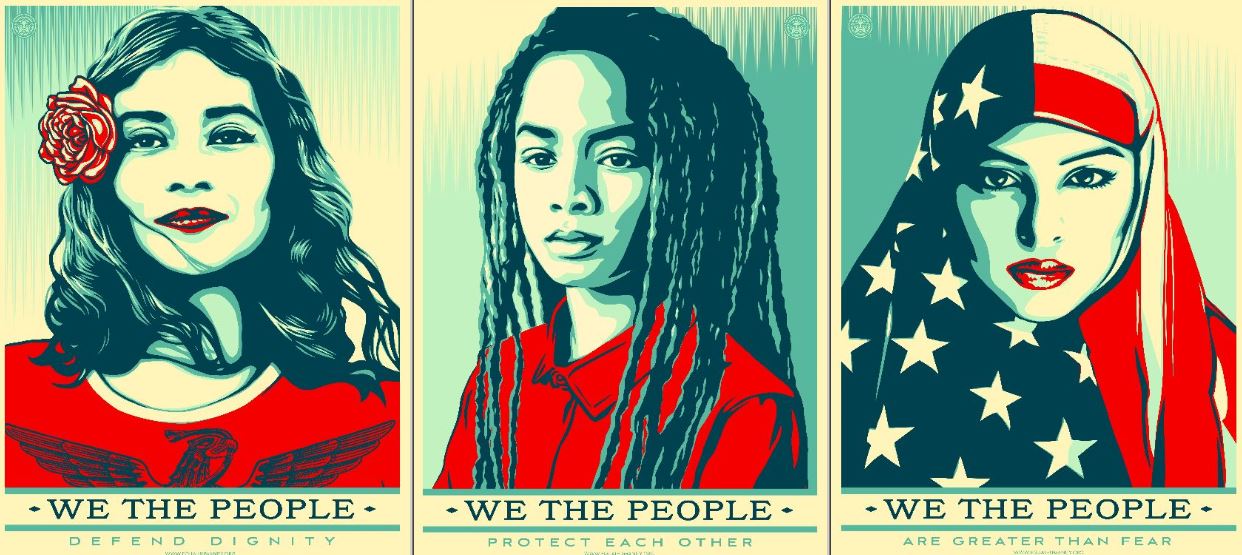
Now with Obama out of office, looks like Fairey may be back in vogue. Sales of George Orwell’s 1984 are up [Fairey did the book cover], and Fairey’s posters were widely seen at the Women’s mach.

George Orwell's '1984' hits bestseller list again
25 Jan 2017
2017 has been "doubleplusgood" for sales of George Orwell's "1984." The famed dystopian novel of life in a totalitarian state sat at No. 6 on Amazon's bestseller list Tuesday morning. The novel's newfound popularity comes several days after White House press secretary Sean Spicer argued defiantly that Trump's swearing-in Friday drew the largest-ever audience for an inauguration "period," despite obvious photo and statistical evidence to the contrary. Senior Trump adviser Kellyanne Conway later defended that argument by saying Spicer's false claims were actually "alternative facts." That phrasing was reminiscent of Orwell's "Ministry of Truth," which, he wrote, concerns itself with "lies."


'Hope' poster creator says he's run out of hope for Obama
29 May 2015
Shepard Fairey says he's run out of hope for President Barack Obama. Fairey is a street artist who is behind the designs for the clothing line OBEY, was featured in the Banksy documentary "Exit Through the Gift Shop" and is most known for designing Obama's famous "Hope" poster. Fairey designed the poster for Obama's 2008 campaign and it became the optimistic symbol of his presidential campaign. When Esquire asked Fairey if Obama lived up to his "Hope" poster, Fairey responded, "Not even close." Fairey told Esquire that he never thought Obama would compromise on issues such as drones and domestic spying.


Obama 'Hope' poster artist Shepard Fairey fined
07 Sep 2012
The US artist who created the well-known "Hope" poster featuring President Barack Obama has been given two years probation and fined $25,000 (£15,000) in a criminal contempt case. He had based his poster on an AP photo and later tried to hide the evidence. Mr Fairey was spared jail but will do 300 hours of community service. The case was settled out of court before a decision was reached, with Mr Fairey agreeing to pay an undisclosed amount of compensation and the two sides agreeing to share the rights to make posters and merchandise bearing the "Hope" image.

Associated Press sues retailers over iconic Obama image
11 Mar 2011
The Associated Press has sued several retailers including Urban Outfitters for the unauthorized use of the Hope image created by artist Shepard Fairey. Street artist Fairey used the photo, taken by Mannie Garcia in 2006, when he created his Hope artwork during Barack Obama's 2008 presidential campaign. Fairey sued AP in 2009, seeking a declaration he had not violated its copyright with his iconic image. AP then counter-sued, saying he had done so through his uncredited and uncompensated use of its picture. The deal agreed in January called for both sides to work together with the image and share future rights to merchandise based on it. 

"Hope" Artist Shepard Fairey Not Pleased With Obama's Performance
In creating his now iconic Obama "Hope" poster, Shepard Fairey went from being a cult street art figure to an artist synonymous with Barack Obama’s revolutionary 2008 presidential campaign. But the artist, whose stylized portrait was emblematic of change, said he hasn't been wowed by Obama's performance in the White House thus far. “Obama is to me a quality human being and someone that, given the limitations of the two-party system, that’s trying to do a good job. The two-party system is not yielding the results I want to see.”

Obama poster artist Shepard Fairey is arrested on tagging charges
08 Feb 2009
Fairey was arrested Friday night in Boston on his way to the Institute of Contemporary Art to DJ at a sold-out party kicking off his first solo exhibition, “Supply and Demand.” Two arrest warrants had been issued Jan. 24 after police determined that he had tagged property in two locations with his street art campaign featuring Andre the Giant and the word "obey," said Boston police officer James Kenneally.

Copyright battle over Obama image
05 Feb 2009
The Associated Press is claiming compensation for the use of one of its photographs to create the most iconic image of Barack Obama. Speaking in an interview with the BBC World Service before the copyright row erupted, he said he was more accustomed to making negative posters of politicians, but was inspired to create a positive image of Barack Obama when he heard him speak at the 2004 Democratic National Convention.


After the Obama poster, Mad Magazine spoofs the style